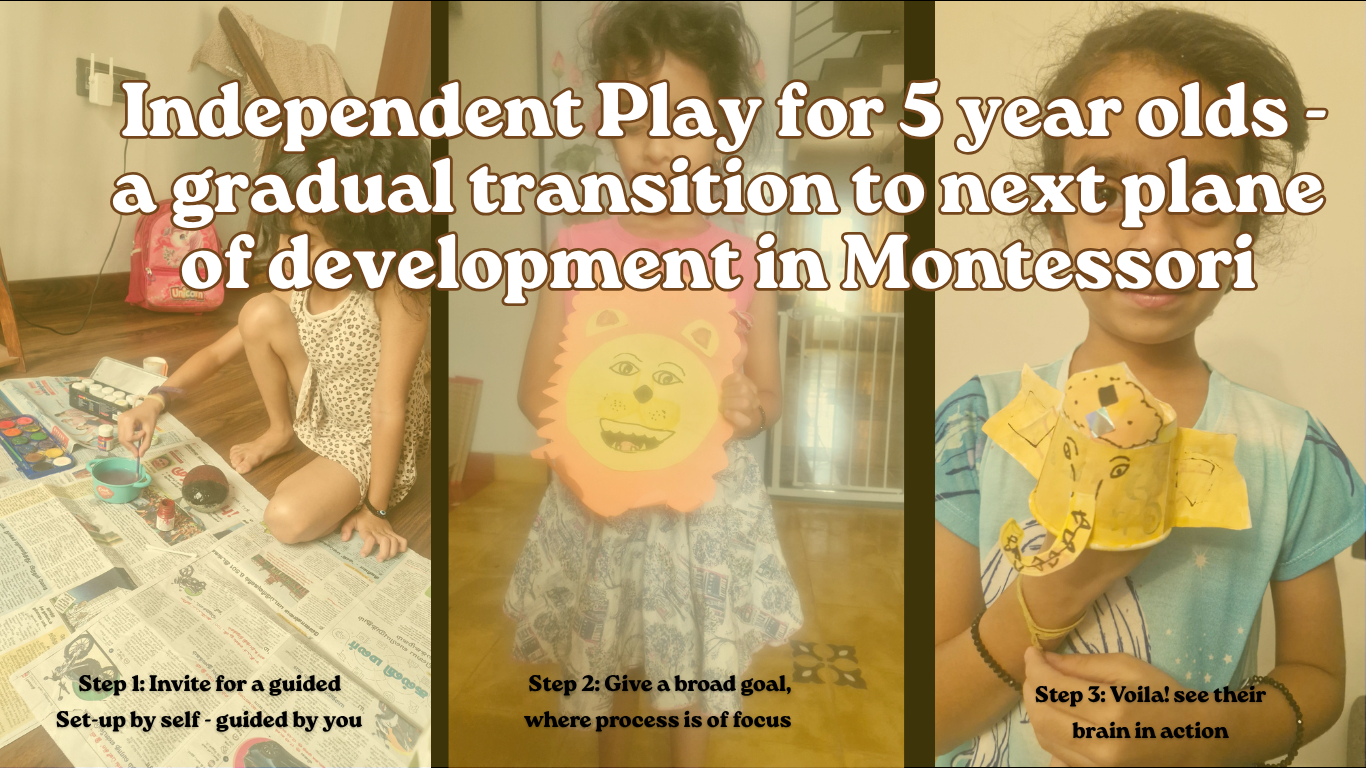
Dhruthi turned six yesterday.
In Montessori, that is not just a birthday. It is a developmental crossing point — the end of the First Plane (0–6 years) and the beginning of the Second. The child who once learned everything by absorbing the world through her senses is now a child who wants to reason about it. To question it. To build her own theories about how things work and why people do what they do.
I did not plan to build an independent play system around a Montessori framework. I planned to survive a summer — 24 weeks pregnant with twins, working full-time, with a five-year-old at home for six weeks — without completely losing my mind. The framework came later, when I looked at what had actually worked and understood why.
This post is about both: the practical system we built, day by day, and the developmental logic underneath it that I wish I had understood sooner.
First: What the Planes of Development Actually Mean
Maria Montessori described child development in four broad planes — each roughly six years long, each with its own learning style, emotional needs, and developmental priorities.
The First Plane (0–6) is the age of the absorbent mind. The child takes in everything — language, culture, movement, social norms — without conscious effort. She does not decide to learn Tamil and English. She just does, because she lives inside both languages. Everything is absorbed.
The Second Plane (6–12) is the age of the reasoning mind. The child shifts from absorbing to questioning. She wants to know why. She develops a moral sense — fairness matters deeply now. Imagination becomes her primary cognitive tool. She is ready for abstract thinking, for longer attention spans, for building and completing complex things over time.
The transition between them — roughly around age six — is not a clean switch. It is a period of overlap where you can see both at work. The child still loves sensory play, still learns by doing and touching. But she is also starting to plan, strategise, hold a longer thought, care about rules and their reasons.
When I understood this, I understood why the activities that had bored Dhruthi at four suddenly lit her up at five turning six. And why the ones that required her to just make something were being replaced by ones where she needed to figure something out.
What Was Actually Happening at Home
Before I built the system, the pattern looked like this: I would be half-present all day, splitting my attention between work and a child who could feel the split. She would ask me to play. I would say “five minutes” sixteen times. By the time I actually sat with her, I was already somewhere else mentally. It was not quality time. It was guilty time — which, if you have been there, you know is a completely different thing.
“Amma, you are reading No Drama Discipline — then why is there so much drama now?”
— Dhruthi, age 5, on a Tuesday afternoon in May
She said this in the middle of a moment where I had been about to raise my voice. The book was literally on my nightstand. I had been highlighting sentences in it every night, feeling like I was getting somewhere. And here was my five-year-old, calmly pointing out the gap between what I was reading and what I was doing.
That was the moment. Not a gradual realisation — a full-stop, mid-sentence moment. Something had to change before the twins arrived.
The System We Built — Four Tracks, One Day
What I needed was not more activities. It was a structure she could own — one that gave her agency at every step, built her capacity for independence gradually, and made our time together, when it came, genuinely ours.
The system runs across four tracks, woven through the day:
- 🧠 Strategic thinking games — Card and board games requiring planning and reasoning. Played together as a reward for completing the morning routine independently.
- 🎨 Arts and crafts — Making things from everyday home materials. Process over product, always. Set up and completed entirely by her.
- 🗺️ Quest session — Scavenger-style afternoon missions with a defined end point. Fully independent, no supervision needed.
- 💬 Thinking games at lunch — No cards, no setup. Just conversation — story chains, “what if” questions, twenty questions with a twist.
Here is what a full day looked like, from 9:30am to 4pm.
The Morning: Ownership Before Anything Else
9:30am — Independent reading (20–30 minutes)
Dhruthi starts every morning with a book — her choice, no prompting. While I took my morning work calls, she read. Over two months of summer break, she finished more than thirty books — mostly chapter books she had chosen herself. This is not assigned reading. It is the first independent act of the day, and it sets the tone for everything that follows: the morning belongs to you.
~10:00am — The sand clock challenge (15 minutes, timed)
A 15-minute sand clock. One job: brush teeth, wash face, change clothes, pack her activity bag — and be at my office door before the sand runs out. The activity bag was the key detail. I had a list ready the night before of exactly what she needed for the day’s craft. She had to read the list, find each item in her room, and pack it herself — then carry it down to my workspace, since I was not meant to climb stairs repeatedly during the pregnancy. This did two things simultaneously: it got her completely ready without me being present for a single step, and it taught her to prepare and pack independently.
~10:20am — The breakfast club (15 minutes)
Breakfast, mostly on her own. On most days she continued reading, or talked to her dolls. On the days she needed company, we invented the Breakfast Club: one doll who only speaks English, one who only speaks Tamil, and the considerable chaos that follows when they try to have a conversation. If you are raising a bilingual child, you will understand exactly how funny this got. The game came from her. I just said yes to it.
By 10:30 to 10:45am, she had read for twenty to thirty minutes, got herself completely ready, packed her own bag, and had breakfast — all without me directing a single step. Reading, sand clock, breakfast: that is already close to an hour of purposeful independent time before the day has properly started.
The Reward: Strategic Thinking Games
~10:45am — Strategic games with Amma (30 minutes)
This is the earned reward for completing the morning routine. Thirty minutes of one-on-one time — fully present, no phone, nothing else. But specifically: games that require her to think. No snake and ladder, no pure-luck dice throws. Strategy card games, logic puzzles, deduction games — things that build the exact skills the Second Plane of development is asking for. Planning ahead. Holding a rule in mind. Thinking about cause and effect. She earned this time, and that distinction mattered more than I expected. Play was no longer what she did while waiting for me. It was what she did to earn me.
The Core: Arts and Crafts

~11:20am — Independent arts and crafts (1 to 1.5 hours)
After our game, she set up for the day’s craft activity — by herself. Newspaper spread on the floor, items unpacked from the bag she had already loaded, workspace arranged. The first day I showed her how. By the second day she was doing it without being asked.
The rule for
all crafts was simple: process over product. How it looked at the end did not matter. That she made something, her way, start to finish — that was the whole point. I would check in occasionally but rarely directed anything. She did not need me there. She needed me to have believed, in advance, that she could do it without me.
The Break and the Conversation
~12:45pm — Bath time (20–25 minutes)
Twenty to twenty-five minutes in the bath — longer in the Bangalore summer heat. No rushing. This is decompression time between making and eating, and she has come to own this too without prompting.
~1:15pm — Thinking games at lunch
Lunch comes with a different kind of thinking game — no cards, no setup, just the two of us talking. Twenty questions with a twist. Story consequence chains: you start a sentence, I continue it, neither of us knows where it ends. “What would happen if” questions that spiral into complete nonsense by the fourth round. These are Second Plane games in disguise — they require imagination, logical sequencing, and holding a premise in mind while building on it. They also mean lunch is never a negotiation about food. She is too busy thinking to notice what she is eating.
The Afternoon: The Quest
~2:00pm — The daily quest (45 minutes to 1 hour)
After lunch, I hand her the quest for the day — a scavenger-style prompt or mission with a defined end point. Letter hunts around the house. Texture detective walks in the garden. Ten minutes watching Veera and writing down everything he does. Mapping a room from memory, then checking. These are done entirely alone. She knows she is finished when the mission says she is finished. She comes back with something to show — and the difference between that and “Amma, I am bored” is everything.
By 4pm she is ready to go outside — swimming, playing with the neighbours, running around. A child who has been genuinely engaged and purposeful from 9:30 in the morning, with short windows of real connection time woven through.
What Made It Work — The Two Mechanisms
The Challenge Quest system
Every completed activity — morning routine, craft, quest — earned a token. Tokens accumulated toward one-on-one time with me. Her choice of what we did. Fully undivided, no exceptions.
This flipped the dynamic entirely. Play was no longer what she did while waiting for me. It was what she did to earn me. She was invested in finishing, not just starting. And when we were together, it was real — not the distracted, fragmented version I had been offering all summer.
Near me, not with me
Especially in the first week, I did not disappear. I stayed in the same space — at my desk while she worked at the dining table, on the sofa while she set up on the floor. She could see me. That proximity was enough to feel safe without requiring my active involvement. Over time, the radius grew naturally. By week three she was in her room while I worked one floor away. But we built to that. We did not start there.
Where Dhruthi Is Now
She turned six yesterday. And what I can say — having watched her across these past weeks — is that the transition Montessori describes is real and visible. The child who used to need me to validate every craft (“is this good, Amma?”) now finishes things and feels it herself. The child who once played for fifteen minutes independently now goes for one to one-and-a-half hours during craft and quest time alone — without prompting, without checking in, without needing the outcome approved.
Add the morning reading and the independent routine, and the total independent time in a day runs to well over three hours. Not screen time. Three hours of purposeful, self-directed, deeply engaged activity — reading, creating, exploring, thinking.
She still wants me. That has not changed. But what she comes back with has. It is no longer “I am bored.” It is “Amma, look what I figured out.” That is a different relationship — with her own capability, and with me.
The Second Plane child is arriving. She has been arriving all summer. And the system we built, which started as a way to survive six weeks of pregnancy and work, turned out to be exactly the right environment for her to step into who she is becoming.
If You Want to Try This
Start with near me, not with me. The goal is not to disappear. The goal is to gradually become less necessary. That takes weeks, not days.
The sand clock works because it makes time concrete. “Fifteen minutes” means nothing to a five-year-old. Watching sand fall means everything.
Let them set up. The act of spreading the newspaper, getting the items, arranging the workspace — that is part of the activity. Do not skip it to save time. That is where the ownership lives.
Process over product, always. If the outcome needs your approval to be finished, you are still part of the activity. Remove the approval step entirely and watch what happens.
The reward has to be real. Not screen time, not a sticker. Undivided time with you, doing something she chose. That is what she actually wants. And it costs nothing except presence.
Build the four tracks in sequence. Start with crafts — the most self-contained. Add the quest once she is comfortable working alone for stretches. Add the strategic games as earned time once the morning routine is running on its own. The lunch thinking games cost nothing and can start immediately.
The full 30-day activity calendar — all four tracks, with specific games, craft ideas, and quest missions — is in the next post. Consider this the why. That is the what.